
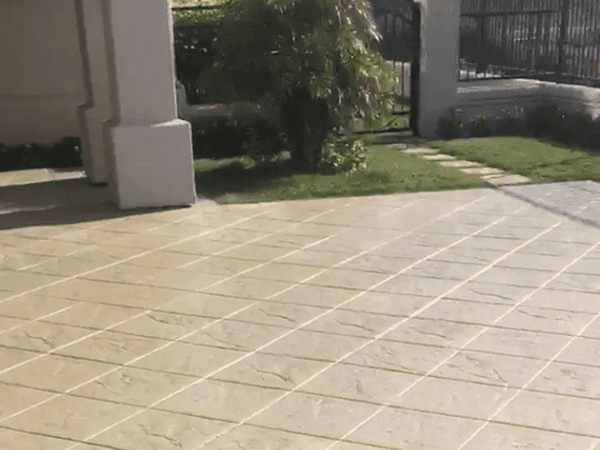
Renewing a patio, driveway or walkway starts with the condition of the existing concrete. Some finishes can be bonded to a suitable slab; pavers and stone may require a different installation system, and some decorative finishes are intended for new concrete. Compare these seven options before deciding what belongs in your project.
Our concrete resurfacing services in San Diego begin with an assessment of the substrate, existing coatings, cracks and drainage.
1. Concrete Overlay
A compatible cement-based overlay can renew the appearance of sound concrete after preparation and necessary repairs. It does not strengthen a failing slab or stop underlying movement. Ask how cracks, moisture, joints and existing coatings will be handled before selecting a smooth, textured or stamped finish.
Texture and sealer selection matter in wet areas. An overlay is not automatically slip-resistant; review a sample appropriate to the intended use.
2. Concrete Pavers
Pavers offer individual units and flexible patterns. Depending on the system and site, installation may use a prepared aggregate base or a specifically designed installation over suitable concrete. Edge restraint, bedding, joints, drainage and finished height need to be planned together.
Standard pavers are not automatically a permeable paving system. If infiltration is a project goal, specify a complete permeable system designed for the site. See our paver installation services.
3. Composite Pavers
Some composite products offer lightweight alternatives for particular applications. Composition, support requirements and traffic ratings vary by manufacturer. Confirm outdoor suitability, fastening or joint details, drainage, fire considerations and the approved substrate before comparing them with concrete pavers.
4. Brick Overlay
Brick can create a traditional appearance, but placing it over existing concrete raises the finished surface. Check thresholds, steps, drainage and the condition of the supporting slab. Compare the complete installation cost and maintenance requirements rather than assuming brick will be cheaper than other materials.
5. Flagstone
Flagstone describes flat paving stone available in different stone types, colors and thicknesses. It is a material choice rather than a thin resurfacing treatment. Discuss the setting system, joint design, existing support, wet traction and additional height before selecting it for a patio or walkway.
6. Exposed Aggregate
An exposed aggregate appearance shows decorative aggregate at the surface. For an existing slab, ask whether the proposed work involves a compatible decorative topping, a limited treatment of the current surface or new concrete. Review a physical sample for appearance, barefoot comfort and wet use; texture alone is not a guarantee against slipping.
7. Top Cast Concrete Finish
TOP-CAST is a surface retarder used to produce exposed aggregate on freshly placed concrete. It is not a spray-on resurfacing mix or a method for strengthening old concrete. It may be relevant when a project calls for new decorative concrete rather than a thin overlay. See Dayton Superior’s TOP-CAST product information for its intended use.
Choose the Scope Before the Finish
Settlement, extensive deterioration or drainage problems may require repairs or replacement before any decorative work. Compare the preparation, finished height, joints, texture, curing time and maintenance of each proposal. Pricing and return-to-use times depend on the site and selected system.
California Clean & Seal serves San Diego County with concrete repairs, resurfacing, staining and new concrete installation. Request an estimate or call (619) 818-0113 to compare options for your surface.


